
Here’s The Problem With Kids Today
Field notes from a night of trespassing and stolen onions.
By Asa Shenandoah
One of the many strange moments in motherhood is realizing your child becomes your mirror. Not the flattering kind either. Not the soft lighting mirrors in department stores that make you look rested and emotionally regulated. I’m talking the brutal kind with fluorescent lighting. The kind that reflects your tone, habits, patience (or lack thereof), your contradictions, your exhaustion, and even your wonder.
Motherhood can convince you that you finally have it all together. Then, just as quickly, reveal maybe you don’t know much at all. Not about life. Not even fully about yourself. Somehow, though, in the dismantling, there is revelation too. A child has a way of pulling apart the pieces of you and forcing you to discover which ones were real all along. Often, revealing a strength you never knew you had to begin with.
As spring gatherings begin again, Easter dinners, Mother’s Day weekends, and folding chairs dragged into wet lawns, I have found myself thinking about the way we speak around children. Why? Because my son is a teenager. I’m paying attention to the new edges in his voice. But also, I’m attempting to clock the attitude he receives from adults, myself included. As friends and families gather, the age-old refrain feels as though it’s making its way around again.
Kids these days.
Recently, another adult attempted to commiserate with me about modern youth and their lack of willingness to go outside. My thirteen-year-old son and his friend stood nearby, and I watched both boys exchange the kind of eye roll that begins in the soul before it reaches the face. As they began to bulge their eyes, I cut a look to let them know, “Do not finish that eye roll!”
My son knows better than to fully commit to disrespect in front of me, but I could feel the restraint in him. Had I granted permission, those eyes would have rolled clear onto the floor and down the hallway. And honestly, I understood.
Because yes, children should be outside more. I agree. The grass is finally thick enough now that my dog disappears into sunny patches of it like an old man retiring to Florida. The thicket behind our house has begun freckling green again. In the mornings, the birds begin before the sun does. But children do not learn through endless griping about what they are not. Human beings absorb the atmosphere around them. They learn through witness. Through repetition. Through example.
The wisest people I have known always taught some version of the same thing: if you want to change the world, begin with yourself. So I tried an experiment.
The wisest people I have known always taught some version of the same thing: if you want to change the world, begin with yourself. So I tried an experiment.
I decided I would become more interested in the outside when he was home. Not because of chores. And I don’t mean performatively interesting. Not the mom-bought-hiking-boots-and-now-thinks-she’s-a-wilderness- woman interesting either. I mean, genuinely awake again. Curious. Participating in the world instead of supervising it from the sidelines, while reminding everyone to put their dishes in the sink.
When children are small, magic comes naturally. A stick becomes a sword. A puddle becomes an ocean crossing. But adolescence can flatten things. The same stick that once defended imaginary villages is now just yard debris delaying the mowing of the lawn. I suspect my son’s chore list of mowing the lawn helped to usher in that new adult worldview that included the death of enchanted objects.
At the same time, as children grow older, mothers begin returning to themselves in strange fragments. My son no longer needs me in the physically exhausting ways he once did. He has his own life now. Friends. Opinions. Privacy. Entire emotional weather systems unrelated to me.
Increasingly, I’ve reclaimed some freedom in my time as my boy grows up. I began revisiting old knowledge passed through my family. One piece of that has been foraging. Learning plants. Walking the woods. Making meals from what most people mow over without noticing.
After teaching my son how to make his bed, clear sticks from the lawn, take out the trash, and cook pancakes from scratch, I realized perhaps I could teach him something else, too:
How to make a salad from the yard.
Yes. Yard salad.
Part survival skill. Part rebellion against modern life. Part attempts to make ordinary places feel enchanted again.
As expected, asking a thirteen-year-old if he wanted to pick wild onions was not exactly landing with cinematic enthusiasm.
“I have a surprise,” I told him.
“I don’t want a surprise,” he replied immediately in his usual teenager-y manner.
Still, he got off the couch and followed me outside, wearing some sort of Crocs with white socks sticking through the giant toe holes. I noticed the footwear and thought briefly about all the times I have warned him to wear real shoes in case of emergencies. What if we break down somewhere? What if we have to walk for help?
Today, the lesson would arrive naturally.
Beyond the edge of the yard, where the mower gives up, and the wildness begins, we found the drainage ditch that runs beside our house. Except back there, it no longer looked like a ditch. It opened into a small creek bordered with flowers. Two ducks drifted through the water, a brown female and a glossy green-headed male trailing after her faithfully, eyeing us suspiciously.
“Those ducks are on a date!” I said.
“That’s cool,” my son answered, but he lingered by the sight. “His head is super shiny. It’s like he’s the one wearing the makeup.”
Engagement. Tiny, but real. I took the win quietly.
Soon, we spotted the wild onions across the creek on what may or may not have technically been our neighbor’s property. My son immediately questioned the legality of our mission. What he did not know was that I had already checked if the neighbors were home before initiating this operation. They were not, but they seemed nice. If they spotted us on the deer cam, it would be a great way to spark a conversation. I live in the suburbs. I was willing to take the risk.
“If they get mad,” I told him, “I’ll bake them a pie.” That seemed to satisfy him. My pies are pretty good, and it also meant he would expect a duplicate pie to stay at home with us (him). That’s our typical arrangement.
I crossed first using a small stepping stone in the middle of the creek. My boots survived with dignity intact.
My son attempted a heroic leap. He missed the ledge a bit. One foot plunged directly into the muddy bank. But instead of annoyance, his eyes widened with triumph.
“Did you SEE how far I jumped? I’ve been working out my legs. It must be paying off.”
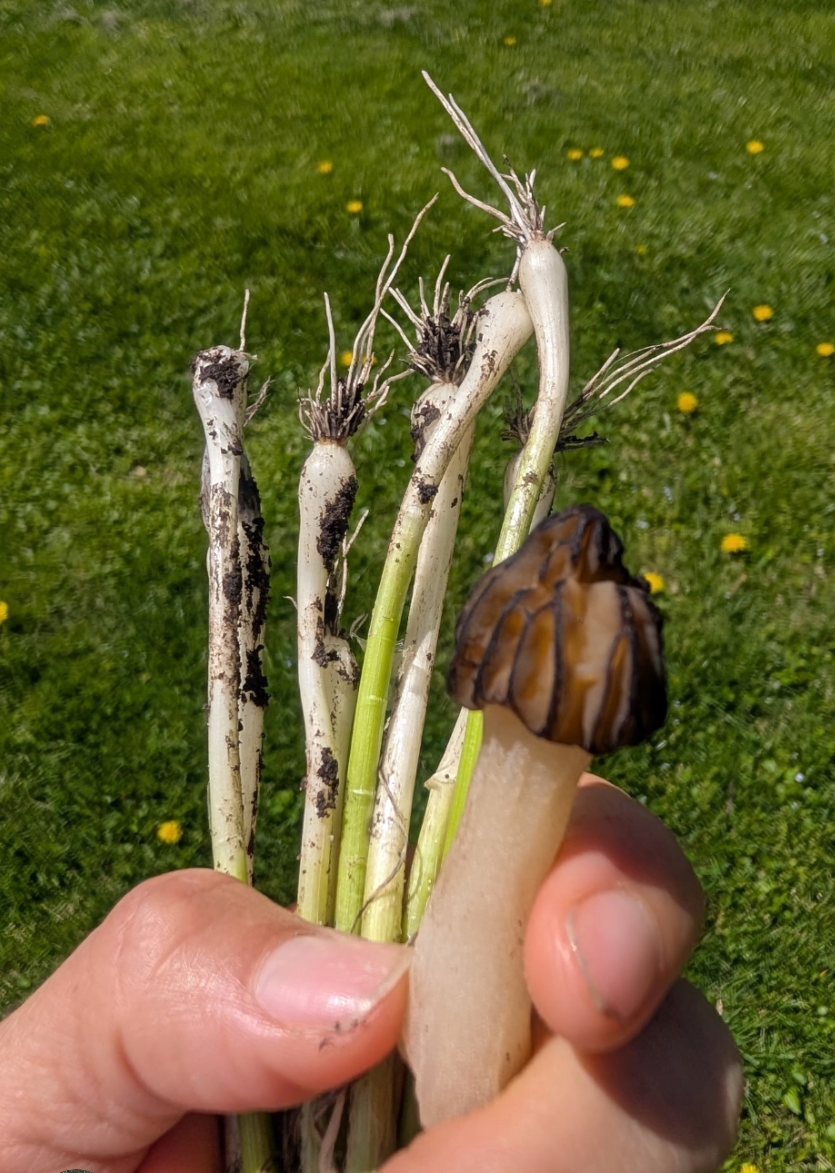
The crushed onion grass released its sharp scent beneath our feet from our jumps. While I dug bulbs from the soft earth. My son wandered instead. Not exactly participating, but I didn’t want to force anymore. I decided to let him have some autonomy here, to see what he might do. Poking sticks into the creek. Investigating holes in the bank. Calling me over every thirty seconds to inspect something extremely important.
And then I saw it.
A tiny morel mushroom pushed sideways from the grass where his giant muddy footprint had nearly flattened it moments earlier.
“Wonder still exists for people willing to crouch low enough to notice.”
My first wild morel. This is a delicacy because, as a general rule, they cannot be commercially cultivated. If you see morels on a menu, someone has been mushroom hunting for you and was kind enough to give them up. I was ecstatic.
It was small enough to fit in my palm, but it felt enormous somehow. Proof that wonder still exists for people willing to crouch low enough to notice. My son was not enthusiastic at first; he is mostly used to my excitement about random things.
That night we made soup with the onions and mushroom. My son, who does not even like mushrooms, ate it anyway after carefully studying the strange little thing on the cutting board like it was an artifact.
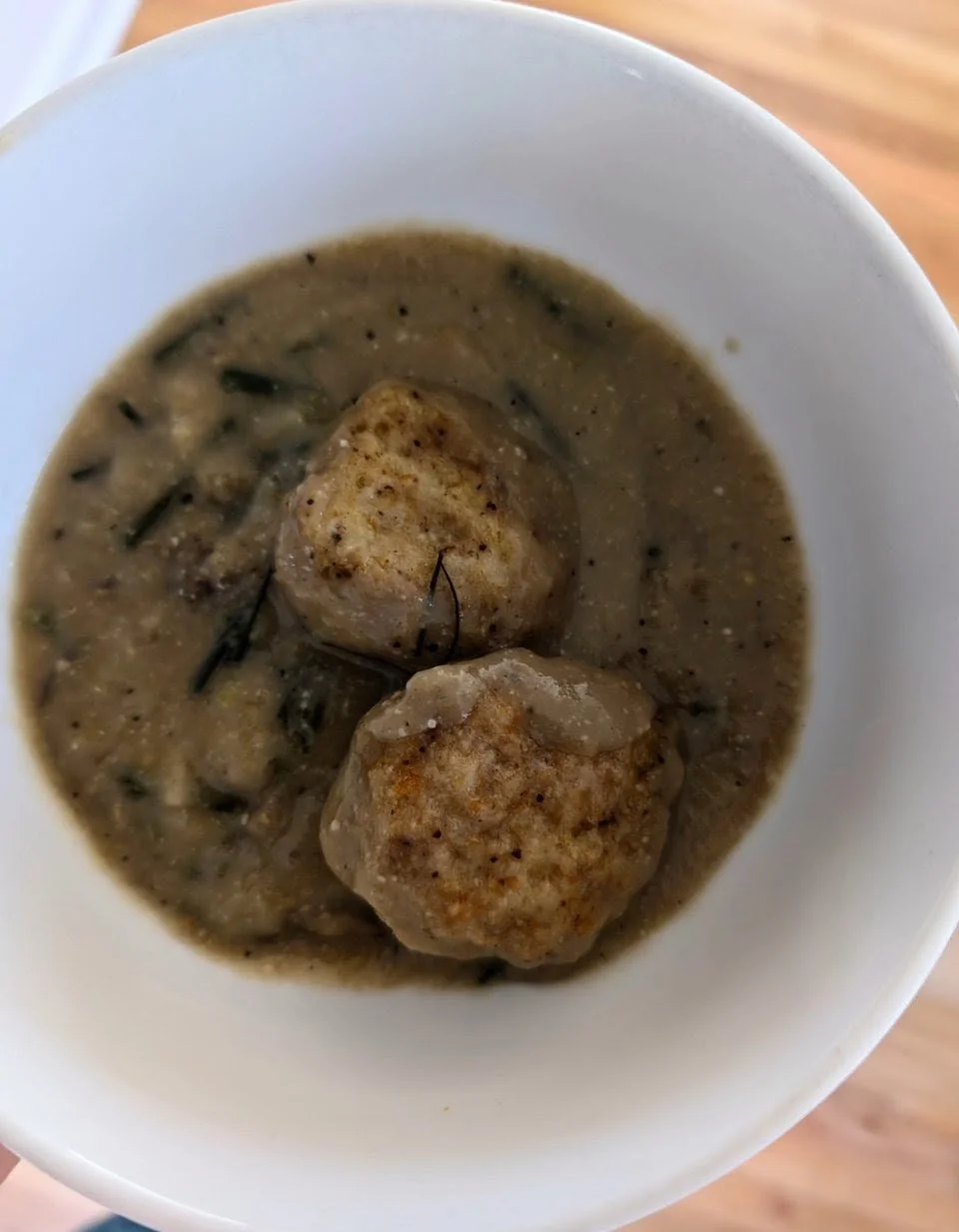
Foraged Soup
Asa and her son made soup from their forged onions and morel mushroom.
Since then, he asks to go outside almost twice a day after school, as if he needed permission. I have to call him repeatedly to come back in. Sometimes he disappears near the creek with the dog until dusk. He now owns a headlamp because apparently nighttime exploration has entered the chat. Yesterday, he told me he thinks he heard giant frogs out there. We are going tonight to see what’s going on back there, but we will definitely be telling the neighbors. His call. Smart move, honestly.
So maybe this is the real point.
People love to say kids these days, but I remember my own childhood. Mama had us hauling brush into burn piles, or she’d have us along to help a friend clean up their yard. I was expected to work some, but at the very least, get lost and play outside nearby. Most adult men seemed to be out tinkering in the garage. My grandmother, even in her 70s, spent time pulling cucumbers from her garden. She’d sliced them right there with salt from her apron pocket.
Adults were participating in life beside us. Not just managing us. Not just correcting us. Living visibly.
Children cannot inherit wonder from people who have abandoned it themselves.
So yes. Maybe it is kids these days.
But it is also us.
And maybe the work now is not simply demanding children return outside, but remembering how to turn the TV off, put the phone down, and meet them there.
Asa Shenandoah is a mother, writer, multidisciplinary artist, and IBEW lineman from the Onondaga Nation with roots in the Tuscarora Nation of North Carolina. Her work often explores motherhood, memory, community, nature, and the strange beauty hidden inside ordinary moments.